
Mini Aussie Shepherd: The Complete Breed Guide
The Mini Aussie Shepherd, often called a mini Aussie dog, is a small, intelligent herding dog known for its loyalty, energy, and close bond with its family. Also widely called the Mini Australian Shepherd, the breed is officially recognized by the AKC as the Miniature American Shepherd. This guide covers size, temperament, exercise, grooming, health, training, and ownership costs to help you decide whether this active dog suits your home.
This small herding dog has the brains, drive, and looks of a full-size Aussie in a body that usually weighs 20 to 40 pounds. It learns fast, sticks close to its people, and needs a real outlet for its energy. In the right home, that mix is wonderful. In the wrong one, you get a bored dog that invents its own jobs.
This guide covers what the breed actually is (including the name confusion), the official size standard, colors, temperament, the health tests the breed club requires, grooming, feeding, cost, and how to find a responsible breeder or rescue. Size, color, and health facts come from the American Kennel Club (AKC) breed standard, the breed’s parent club, the Orthopedic Foundation for Animals, and university genetics labs, not from breeder marketing.
What’s In This Guide
Mini Aussie Shepherd at a Glance
| Official AKC name | Miniature American Shepherd |
| Common names | Mini Australian Shepherd, Miniature Australian Shepherd, Mini Aussie, MAS |
| AKC group | Herding Group (full recognition July 1, 2015) |
| AKC popularity | No. 28 of 202 breeds in 2025 (No. 24 in 2024) |
| Height | Males 14–18 in, females 13–17 in at the withers |
| Typical weight | About 20 to 40 pounds |
| Life expectancy | About 12 to 13 years |
| Recognized colors | Black, blue merle, red (liver), red merle, with or without white and/or tan |
| Coat | Medium-length double coat, straight to wavy, sheds year-round |
| Exercise | At least 1 hour a day, ideally 2 |
| Required health tests | Hips, annual eye exam, PRA-prcd, MDR1, HSF4 cataracts, NAD |
Mini Australian Shepherd vs. Miniature American Shepherd: Same Dog, Two Names

Mini Aussie is a common nickname for the Mini Australian Shepherd, while Miniature American Shepherd is the official breed name recognized by major kennel organizations.
For decades the dogs were bred and sold as “Miniature Australian Shepherds.” When the breed moved toward AKC recognition, it entered the AKC’s Foundation Stock Service in May 2011 as the Miniature American Shepherd, a name that also reflects where the breed was developed. The Miniature American Shepherd Club of the USA (MASCUSA) is the AKC parent club.
Internationally, the Fédération Cynologique Internationale (FCI) accepted the breed on a provisional basis on September 4, 2019, also under the Miniature American Shepherd name (standard No. 367). Some other registries and many breeders still use “Miniature Australian Shepherd.”
What this means for you: A puppy advertised as a Mini Aussie, Mini American, or Miniature American Shepherd can be the same kind of dog. The registration papers and the parents’ health test results tell you far more than the name in the ad.
For the full registry story, see our guide to Mini Australian Shepherd vs. Miniature American Shepherd.
History of the Mini Aussie
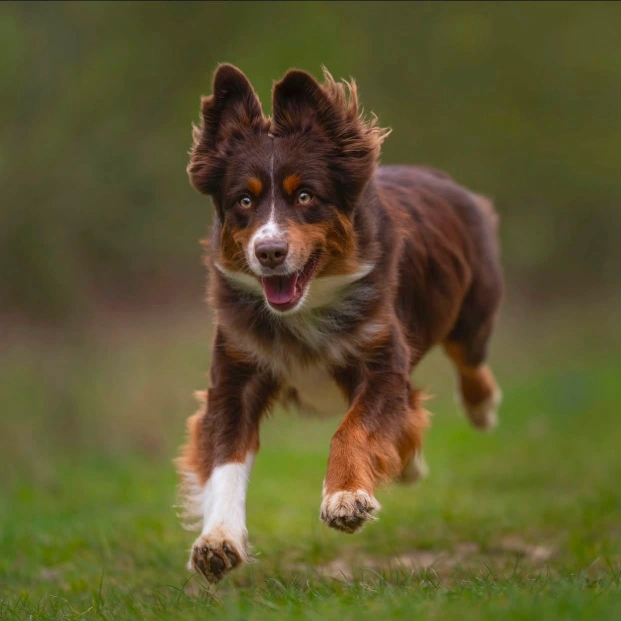
Developed in California in the late 1960s from small dogs thought to be Australian Shepherds.
According to the breed history published by MASCUSA:
- Late 1960s: The breed was developed in California from small, unregistered dogs thought to be Australian Shepherds. Breeders aimed to keep the small size, active character, and intelligence.
- 1980: First registered with the National Stock Dog Registry, under the name Miniature Australian Shepherd.
- Early 1990s: The dogs reached nationwide popularity and were shown with various rare-breed organizations.
- 1990 and 1993: MASCUSA, the first parent club and registry, formed in 1990 and incorporated in 1993.
- May 2011: The breed entered the AKC Foundation Stock Service as the Miniature American Shepherd.
- July 1, 2015: The AKC granted full recognition in the Herding Group, alongside the Berger Picard and Lagotto Romagnolo.
MASCUSA notes that the breed has been used to herd smaller stock such as sheep and goats, and that it became especially popular with equestrians traveling to horse shows because its intelligence, loyalty, and size made it an easy travel companion.
Mini Aussie Dog Size and Appearance
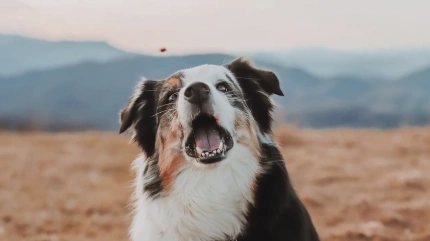
The AKC standard defines size by height at the withers, not by weight.
| Height (AKC standard) | Disqualified if | |
|---|---|---|
| Males | 14 to 18 inches | Under 14 or over 18 inches |
| Females | 13 to 17 inches | Under 13 or over 17 inches |
The minimum heights don’t apply to puppies under six months old. Most adults weigh about 20 to 40 pounds, depending on sex, height, and build.
According to the standard, a correct Mini Aussie is slightly longer than tall, with moderate bone and no extremes. The ears are triangular and set high, breaking forward or to the side when the dog is alert. Prick ears and ears that hang with no lift are listed as a severe fault, so a straight-up “prick-eared” Mini Aussie is not what the standard describes. A docked or natural bobtail is traditional, and a docked tail should not exceed three inches, but many pet Mini Aussies have full tails.
Eye color is one of the breed’s signatures. The standard accepts brown, blue, hazel, amber, or any combination, including flecks and marbling, and the two eyes don’t need to match.
For growth expectations month by month, see our Mini Australian Shepherd Size and Growth Guide.
Mini Aussie vs. Standard Australian Shepherd vs. “Toy” Aussie
| Standard Aussie | Mini Aussie (MAS) | “Toy” Aussie | |
|---|---|---|---|
| Height | 20–23 in (M), 18–21 in (F) | 14–18 in (M), 13–17 in (F) | Marketed smaller than Mini |
| Typical weight | About 40–65 lb | About 20–40 lb | Varies widely by breeder |
| AKC recognized | Yes (Herding Group) | Yes (since 2015) | No |
“Toy” and “teacup” Aussies are not AKC-recognized breeds, and adult size claims for them vary from seller to seller. The AKC Mini standard disqualifies dogs below its minimum heights, so a dog marketed as extra-small is, by definition, outside the breed standard. See our Toy vs Mini vs Standard breakdown.
Comparing the Mini Aussie with a larger family companion? Read our Mini Aussie vs. Golden Retriever comparison.
Mini Australian Shepherd Colors and Markings
The AKC standard recognizes four base colors, with no order of preference:
Each can appear with or without tan (copper) and/or white markings. Tan ranges from creamy beige to dark rust. White is allowed on the muzzle, face, neck, chest, belly, and legs, but the eyes must be fully surrounded by color. Large white body splashes between the withers and tail, or any color outside the four recognized ones, are disqualifications in the show ring.
Nose and eye-rim pigment follows the base color: black on blacks and blue merles, red (liver) on reds and red merles.
A Word About Merle Genetics
Merle is inherited through incomplete dominance. Breeding two merle dogs together can produce “double merle” puppies, which the UC Davis Veterinary Genetics Laboratory says may have hearing, eye, skeletal, and other defects. Some dogs carry a merle variant without showing an obvious merle pattern (often called “cryptic merle”), which is why MASCUSA lists the M locus (merle) DNA test as important for safe breeding. A responsible breeder never pairs two merles.
See every color and pattern in our Mini Australian Shepherd Colors Guide.
Mini Aussie Shepherd Temperament
The AKC standard describes the breed as intelligent and primarily a working dog with strong herding and guardian instincts. It’s versatile and easily trained, reserved with strangers but not shy, and protective, good-natured, devoted, and loyal with its family. A Mini Aussie dog is often intelligent, alert, eager to learn, and closely bonded with its family. Early socialization, consistent training, and daily physical activity help support good behavior.
In daily life, that usually looks like this:
- A shadow. Many Mini Aussies follow their person from room to room and want to be part of everything.
- A fast learner. They pick up cues quickly, including the habits you didn’t mean to teach.
- A herder. Circling, staring, and nipping at the heels of running kids, bikes, or other pets is normal herding behavior. It needs to be redirected, not punished.
- A watchdog. Most will bark to announce visitors, and many are cautious with strangers, so early socialization matters.
Are Mini Aussies Good Family Dogs?
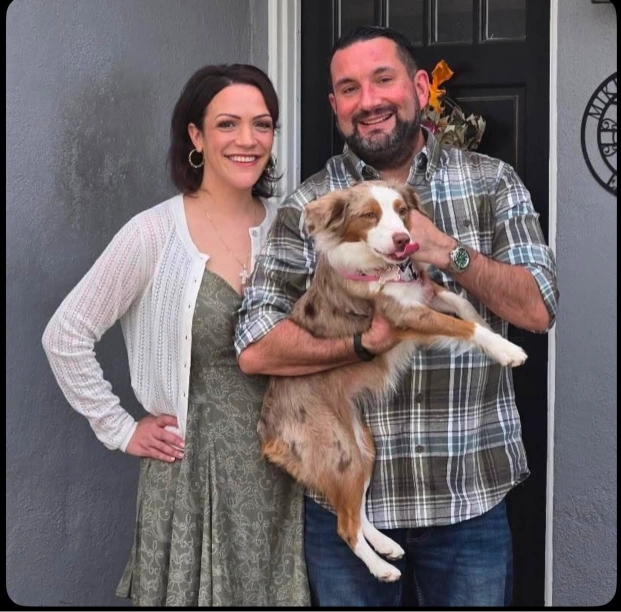
Yes, for active families. Well-socialized Mini Aussies usually do well with children and other dogs. Supervise early interactions, and introduce a new dog or cat slowly. The two biggest friction points are herding behavior toward small children and the breed’s daily activity needs.
Do Mini Aussies Get Along With Cats and Small Pets?
Many live happily with cats when raised with them or introduced carefully. Expect some herding attempts. Be more cautious with small pets such as rabbits or guinea pigs, since chasing fast-moving small animals is exactly what a herding dog is wired to do.
Do Mini Aussies Bark a Lot?
They’re alert and vocal, so expect alarm barking. Boredom and too little exercise make barking worse. Early socialization, reward-based training, and enough daily activity keep it manageable.
Can a Mini Aussie Be Left Alone?
This is a people-focused breed, and some individuals develop separation anxiety. Build alone time gradually from puppyhood, use crate training, and leave interactive toys. A Mini Aussie alone for long workdays with no midday break is likely to struggle.
Read more in our Mini Australian Shepherd Temperament Guide.
Exercise and Mental Stimulation
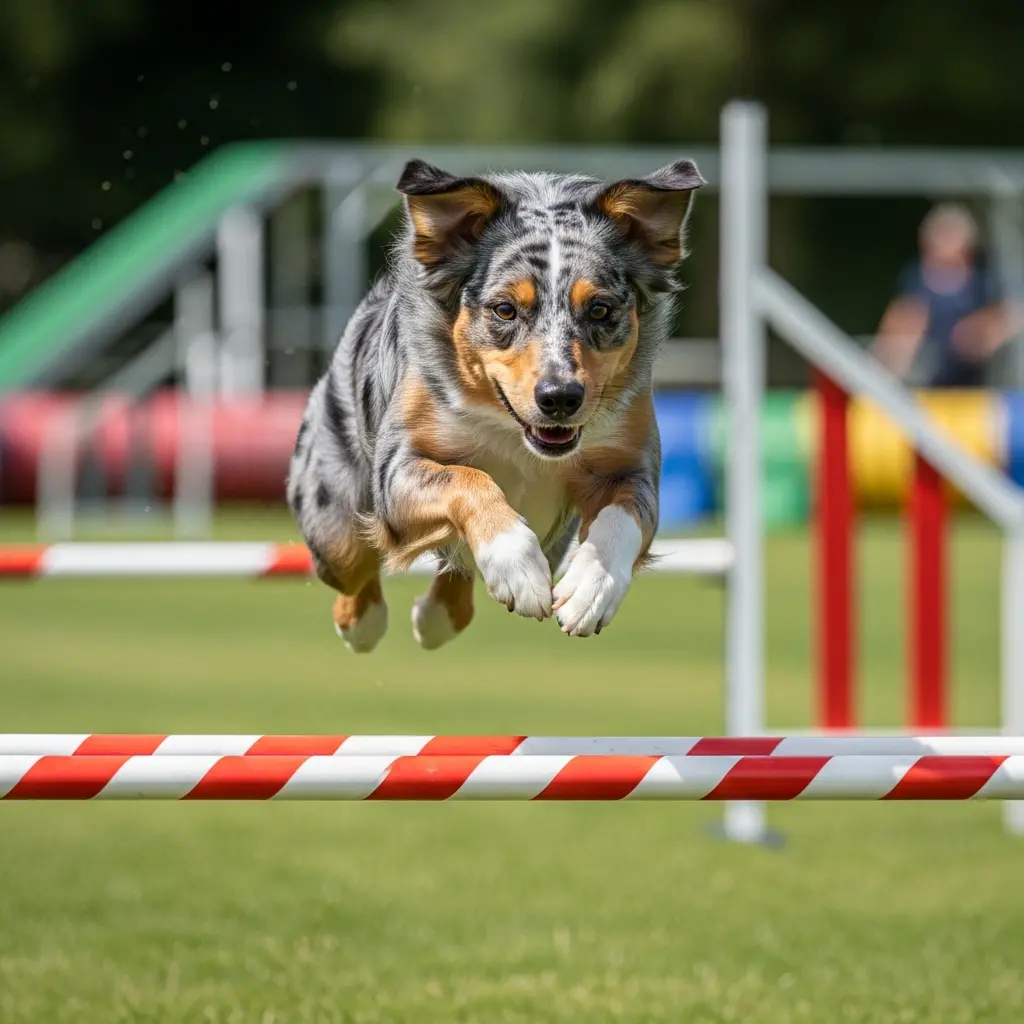
Dog sports meet both the physical and mental side of this breed’s needs in one session.
A smaller body doesn’t mean a smaller engine. Veterinary guidance from PetMD puts the breed’s needs at a minimum of one hour of exercise a day, and ideally two, plus activities that engage the mind.
Good outlets include:
- Brisk walks, jogs, and hikes
- Fetch, frisbee, and running in a securely fenced area
- Dog sports such as agility, herding, rally, tracking, and dock diving
- Short daily training sessions and trick training
- Puzzle feeders, interactive toys, and scent games
A Mini Aussie that doesn’t get enough to do often finds its own work: barking, chewing, digging, or herding the household. Apartment life can work, but only if you’re committed to getting the dog out for real exercise every day.
For age-by-age routines, see our Mini Australian Shepherd Exercise Guide.
Training Your Mini Aussie
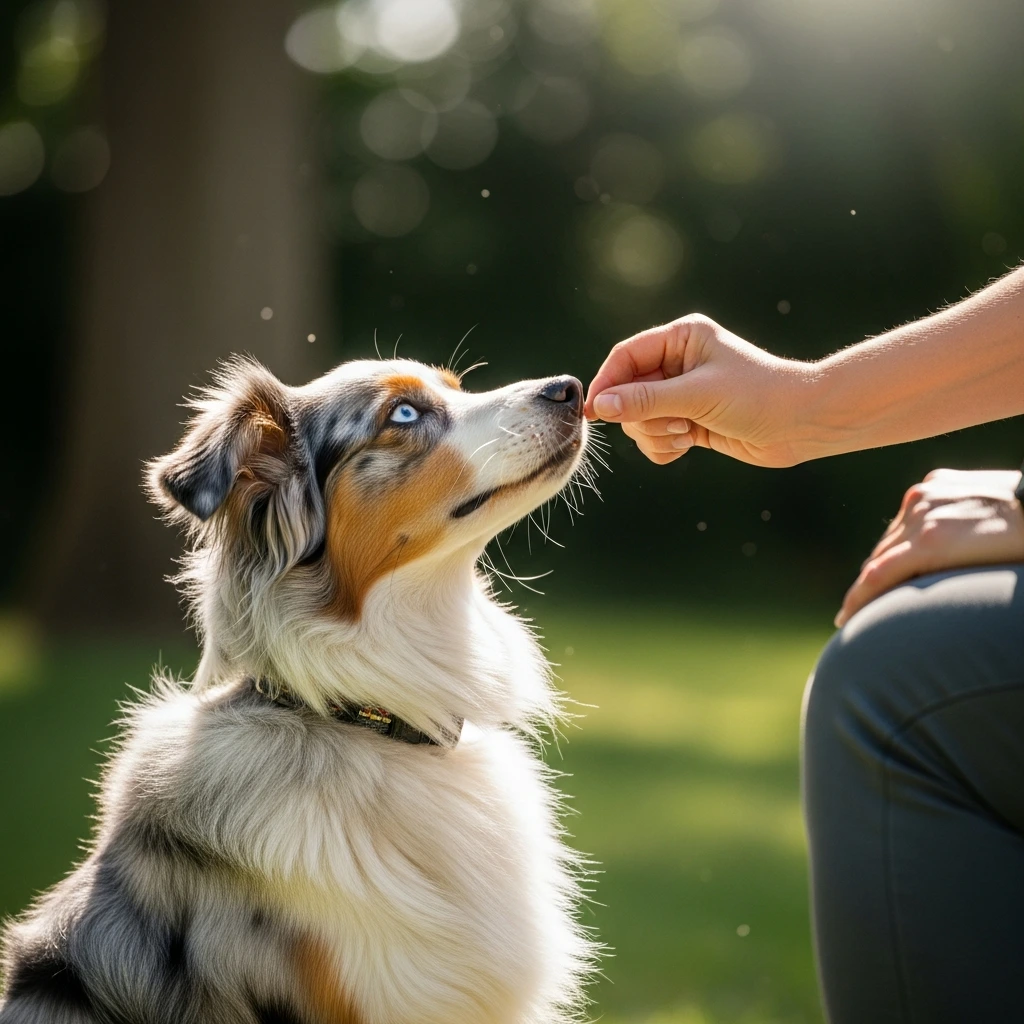
This breed is highly trainable, which cuts both ways. Mini Aussies learn good habits quickly and bad ones just as fast, so consistency matters from day one.
Use reward-based training. The American Veterinary Society of Animal Behavior (AVSAB) recommends that only reward-based methods be used for all dog training, including behavior problems, and says aversive methods such as leash corrections, prong collars, and shock collars should not be used. Older advice about being the “pack leader” or dominating your dog is not supported by AVSAB’s current position.
Training priorities for a Mini Aussie:
- Socialization with many people, places, sounds, and friendly dogs during puppyhood.
- A reliable recall and a solid “leave it,” since the herding instinct can send them after moving things.
- Impulse control, such as waiting at doors and settling on a mat.
- Redirecting herding into toys and games instead of ankles.
- Alone-time training, practiced gradually so your dog learns to relax when you leave.
Our Mini Australian Shepherd Training Guide and Mini Aussie Puppy Guide walk through each stage. If your adolescent suddenly stops listening, that’s covered in our adolescent phase guide.
Grooming and Shedding
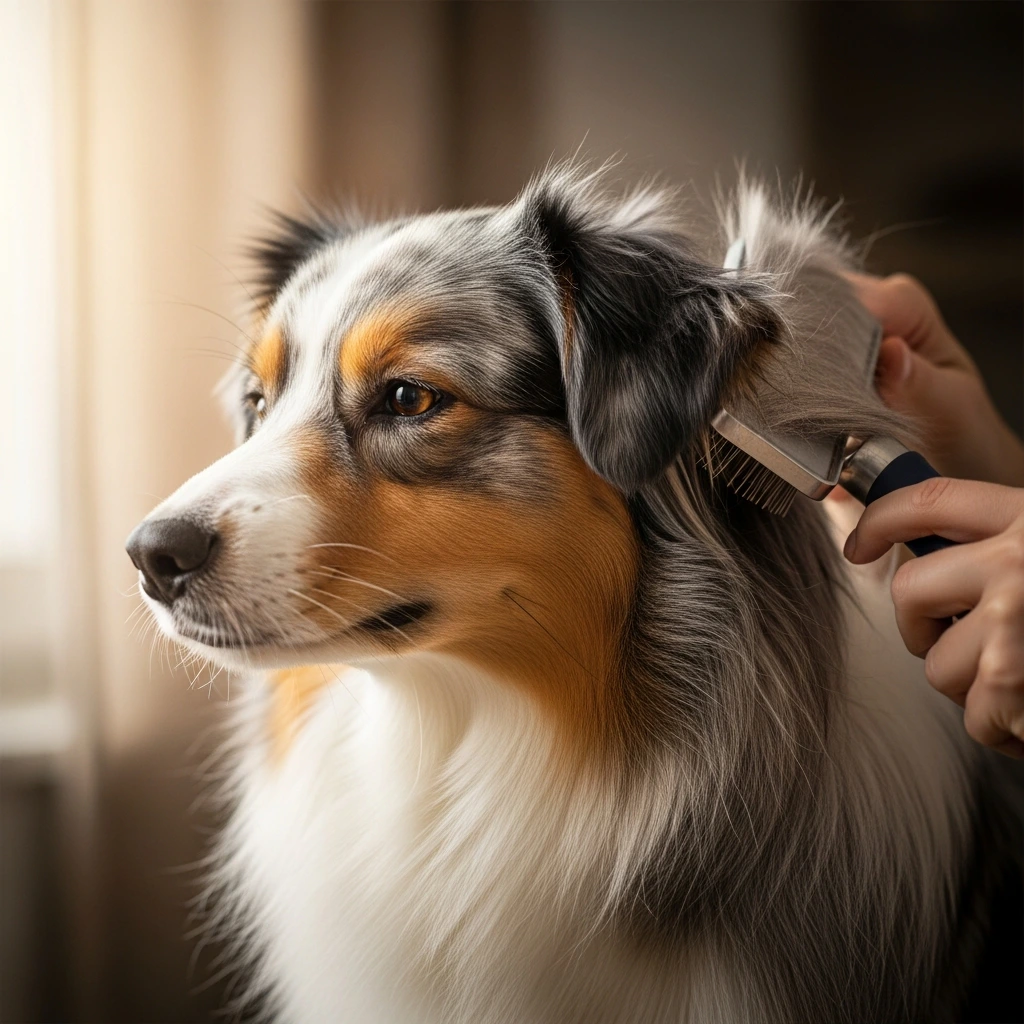
A slicker brush and an undercoat rake do most of the work on a double coat.
The Mini Aussie has a medium-length, weather-resistant double coat that is straight to wavy, with feathering on the backs of the legs and a mane and frill around the neck. The AKC standard notes that the undercoat varies with the climate.
What to expect:
- Shedding: Year-round, with one or two heavy shedding seasons, usually in spring and/or fall.
- Brushing: At least weekly, and every day during heavy shedding. Check behind the ears, where mats form easily.
- Bathing: Only when your dog is dirty.
- Trimming: The standard allows trimming on the ears, feet, back of the hocks, pasterns, and tail. Don’t shave the double coat.
- Ears: The breed isn’t especially prone to ear infections, but check and clean ears after baths or swimming.
- Eyes: Because the breed is at risk for several inherited eye conditions, watch for redness, discharge, cloudiness, or bumping into things.
- Nails and teeth: Trim nails regularly and brush teeth often.
Mini Aussies are not hypoallergenic. If allergies are a concern, spend time with the breed before committing. For coat-related skin issues, see our guide to Mini Aussie allergies.
Step-by-step instructions are in our Mini Australian Shepherd Grooming Guide.
Mini Aussie Shepherd Health and Common Conditions
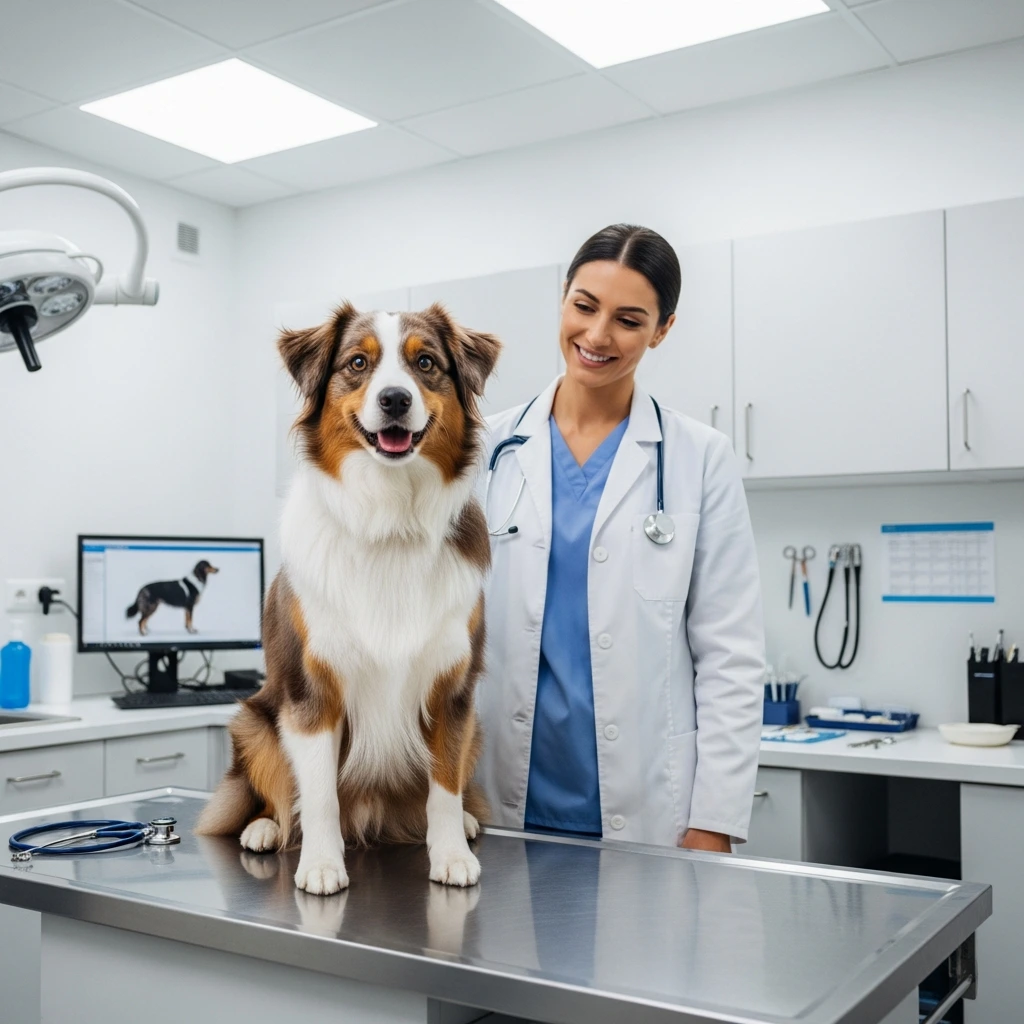
Many inherited conditions in this breed can be screened for before breeding.
Mini Aussies are generally a healthy breed, but they share several inherited conditions with Australian Shepherds. The good news is that many can be screened for before breeding, and the breed club spells out exactly which tests it expects.
Health Tests Required by the Breed Club
MASCUSA lists six tests as required for the OFA/CHIC program, the AKC Breeder of Merit program, and its Bred with H.E.A.R.T. program:
| Required test | What it screens for |
|---|---|
| Hip dysplasia radiograph | Malformed hip joints that lead to pain and arthritis |
| ACVO eye exam (annual) | Inherited eye disease, by a board-certified veterinary ophthalmologist |
| PRA-prcd DNA test | Progressive retinal atrophy, a cause of gradual blindness |
| MDR1 DNA test | Multidrug sensitivity |
| HSF4 DNA test | Hereditary cataracts (Australian Shepherd type) |
| NAD DNA test | Neuroaxonal dystrophy (Miniature American Shepherd type) |
MASCUSA also strongly recommends elbow and patella evaluations, an OFA dentition evaluation, and DNA tests for collie eye anomaly (CEA), degenerative myelopathy (DM), chondrodystrophy (CDDY), chondrodysplasia (CDPA), hyperuricosuria (HUU), and multifocal retinopathy 1 (CMR1). The M locus (merle) test is on its optional list.
Two tips when you review a breeder’s paperwork:
- Look the parents up yourself. The OFA database is public and searchable by the dog’s registered name.
- A CHIC number is not a pass mark. It means all required tests were done and made public. It does not mean every result was normal, so read the actual results.
Not every lab offers every test. MASCUSA notes, for example, that several large commercial panels do not include the NAD test, so ask which lab ran it.
MDR1: The Health Issue Every Owner Must Know
The MDR1 (ABCB1) mutation makes dogs sensitive to certain drugs. Both Washington State University and the UC Davis Veterinary Genetics Laboratory estimate the mutation frequency in this breed at about 50%. UC Davis lists signs of drug toxicity in affected dogs as tremors, loss of coordination, excess drooling, seizures, slow heart rate, dilated pupils, and in severe cases respiratory arrest.
What Washington State University’s current problem-drug list says:
- Loperamide (Imodium) causes neurological toxicity at diarrhea-treatment doses in dogs with the mutation and should be avoided.
- Common heartworm and flea preventives such as Heartgard (ivermectin), Interceptor (milbemycin), Revolution (selamectin), and the moxidectin products were tested by their manufacturers and found safe for MDR1 dogs at label doses.
- Other drugs including acepromazine, butorphanol, grapiprant (Galliprant), maropitant (Cerenia), ondansetron, cyclosporine, and some chemotherapy drugs may need dose changes.
- Livestock ivermectin formulations are a different story. WSU’s safety finding applies to label doses of pet products, not to farm dewormers, so keep your dog away from them and from manure of recently treated animals.
WSU also notes that MDR1 dogs are prone to relative adrenal insufficiency when seriously ill, which is worth mentioning to any emergency vet.
What to do:
- Test your dog with a cheek-swab DNA test, unless both parents are documented Normal/Normal.
- Share the result with every veterinarian, emergency clinic, and boarding facility that cares for your dog.
- Never give over-the-counter medications without checking with your vet first.
Our MDR1 Gene Guide explains results in detail, and the MDR1 Drug List covers medications to discuss with your vet.
Other Conditions Seen in the Breed
- Cataracts, including juvenile cataracts that appear at a young age
- Progressive retinal atrophy, often diagnosed between 3 and 9 years of age
- Collie eye anomaly, a congenital defect ranging from no symptoms to blindness
- Iris coloboma, a hole in the iris present at birth that may cause light sensitivity
- Hip dysplasia and elbow dysplasia
- Luxating patella (slipping kneecaps)
- Degenerative myelopathy, a progressive spinal cord disease
- Epilepsy, seen across herding breeds
Regular vet visits, a lean body weight, and buying from health-tested parents are the three biggest things you control. For symptoms and treatment options, see our breed health issues guide.
Mini Aussie Dog Lifespan
Veterinary breed profiles, including PetMD’s, put the Miniature American Shepherd’s average lifespan at 12 to 13 years. Many individual dogs live longer with sound genetics, a healthy weight, regular exercise, and preventive care.
See our Mini Aussie Shepherd Lifespan Guide for what affects longevity and how to care for a senior Mini Aussie, plus our deep-dive on what most affects how long they live.
Feeding a Mini Aussie
PetMD’s veterinary guidance for the breed:
- Puppy (first 12 months): a high-quality, calorie-dense puppy food formulated for medium breeds.
- Adult (from about 1 year): transition over five to seven days to an adult medium-breed formula.
- Senior (around 8 years): consider a senior diet with joint support.
- Meals: two a day, morning and evening. A slow-feeder bowl helps fast eaters.
- Treats: about 90% of daily calories from complete and balanced (AAFCO-compliant) food and no more than 10% from treats.
- Supplements: not needed on a complete diet unless your vet recommends one.
Measure every meal and adjust portions to your dog’s body condition. Excess weight adds strain to hips and elbows, which matters in a breed screened for dysplasia.
Details and sample portions are in our Mini Aussie Nutrition Guide, and specific product guidance is in our best dog food guide.
How Much Does a Mini Aussie Shepherd Cost?
There’s no official price for the breed, and prices vary by region, lineage, and breeder:
- Pet retailer Chewy puts the typical range for a puppy from a reputable breeder at about $1,200 to $2,500.
- Puppies with show or breeding rights usually cost more.
- Rover’s 2024 Cost of Pet Parenthood survey found that upfront expenses for a new dog typically run $870 to $4,565 in the first year.
- Rover puts professional grooming at roughly $50 to $125 per appointment.
Budget for vaccines, spay or neuter surgery, an MDR1 test if the breeder hasn’t done one, food, a crate, grooming tools, training classes, annual vet care, and pet insurance or an emergency fund.
A very cheap puppy is usually a red flag. Health testing both parents costs real money, and sellers who skip it can undercut responsible breeders on price.
For a full first-year and lifetime budget, see our Mini Aussie Cost Guide..
Is a Mini Australian Shepherd Right for You?
| Great fit if you… | Probably not a fit if you… |
|---|---|
| Enjoy daily walks, hikes, or dog sports | Want a low-energy, couch-only dog |
| Like training and teaching new skills | Are away from home most of the day |
| Want a loyal dog that goes everywhere with you | Can’t tolerate dog hair on clothes and furniture |
| Can handle weekly brushing and heavy seasonal shedding | Need a hypoallergenic breed |
| Have time to socialize a puppy thoroughly | Have toddlers and no time to manage herding behavior |
Still weighing options? Compare the breed against a Border Collie, Corgi, Sheltie, Aussiedoodle, or Standard Poodle.
How to Find a Responsible Breeder or Rescue
Where you get your dog matters as much as which dog you get. A little diligence up front prevents a lot of heartache later.
Questions to Ask a Breeder
- Can I see the OFA results for both parents, including hips, the annual ACVO eye exam, and the DNA tests for PRA-prcd, MDR1, HSF4, and NAD?
- Which lab ran the NAD test?
- Is either parent merle? If so, is the other parent non-merle, and has it been DNA tested for merle?
- Has the puppy’s hearing been checked, especially if it’s merle?
- What registry are the puppies registered with?
- Can I meet the mother and see where the puppies are raised and socialized?
- Do you provide a written contract, and will you take the dog back if I can’t keep it?
Walk away from breeders who can’t show health results, promise a specific “toy” adult weight, charge extra for “rare” colors or double merles, pressure you to pay immediately, or ship puppies without talking to you first.
Adopting a Mini Aussie
Mini Aussies and Mini Aussie mixes do end up in shelters and rescues, often because an owner underestimated the breed’s energy. MASCUSA runs a rescue program, and general adoption sites are worth checking too. An adult rescue has the advantage of a known size and personality. If a rescued dog’s MDR1 status is unknown, test it.
Preparing for a new puppy? Start with our Mini Aussie Puppy Guide and potty training guide. Have a question? Get in touch.
Frequently Asked Questions
Is a Mini Australian Shepherd the same as a Miniature American Shepherd? +
Yes. “Miniature American Shepherd” is the name used by the AKC and the FCI. “Mini Australian Shepherd” or “Mini Aussie” is the traditional name still used by some registries, breeders, and most owners.
How big does a Mini Australian Shepherd get? +
Under the AKC standard, males stand 14 to 18 inches at the withers and females 13 to 17 inches. Most adults weigh about 20 to 40 pounds.
How much exercise does a Mini Aussie need? +
At least one hour a day, and ideally two, plus training or puzzle work for mental stimulation.
Do Mini Aussies shed a lot? +
Yes. They shed year-round with one or two heavy seasons, usually spring and fall. Brush at least weekly, and daily during heavy shedding.
Are Mini Australian Shepherds good for first-time owners? +
They can be, if the owner is ready to put real time into training, socialization, and daily exercise. First-time owners who want an easygoing, low-activity dog usually find another breed a better match.
Can a Mini Aussie live in an apartment? +
Yes, as long as it gets plenty of daily exercise and mental stimulation outside. For this breed, activity level matters more than home size.
How long do Mini Australian Shepherds live? +
About 12 to 13 years on average, and many live longer with good care.
Do all Mini Aussies need an MDR1 test? +
Testing is strongly recommended. About half of Mini Australian Shepherds carry the mutation, and the result changes which medications and doses are safe. The only exception is a dog whose parents are both documented Normal/Normal.
Are Mini Aussies recognized by the AKC? +
Yes. The AKC fully recognized the breed as the Miniature American Shepherd on July 1, 2015, in the Herding Group.
How do I stop my Mini Aussie from barking so much? +
Start by meeting your Mini Aussie’s exercise and mental-stimulation needs, then reward quiet behavior and teach a reliable “quiet” cue. Find the trigger – doorbells, passersby, boredom – and manage it while you train. Our guide to stopping Mini Aussie barking walks through each step.
What should I know about caring for a senior Mini Aussie? +
Senior Mini Aussies slow down, may show cognitive changes such as nighttime restlessness, and need more frequent vet checkups. Keep yours lean, adapt exercise to aging joints, and watch for vision or hearing loss. See our senior Mini Aussie care guide for diet, vet care, and comfort tips.
Why is my Mini Aussie afraid of strangers? +
Wariness of strangers is a normal breed trait – Mini Aussies were bred to be watchdogs. Build confidence with gradual desensitization: reward calm behavior around new people at a distance and never force interactions. Learn more in our guide to Mini Aussie fear of strangers.
Sources
- AKC, Official Standard of the Miniature American Shepherd
- AKC, Herding Group Health Testing Requirements
- AKC, The Most Popular Dog Breeds of 2025
- MASCUSA, Breed Health
- MASCUSA, Breed History
- Orthopedic Foundation for Animals, CHIC Program
- FCI, Miniature American Shepherd (No. 367)
- Washington State University, MDR1 in Dogs
- UC Davis VGL, Multidrug Sensitivity (MDR1)
- UC Davis VGL, Merle
- PetMD (Michelle Diener, DVM), Miniature American Shepherd
- AVSAB, Position Statements
