
🐾 Training Hub
Mini Australian Shepherd Training: The Complete Guide
The age-by-age timeline, command order, and herding-instinct fixes that generic Aussie training guides skip entirely.
Quick Answer
Mini Australian Shepherds are among the fastest-learning dogs in the world, but this breed needs a different training approach than most: short, varied sessions to prevent boredom, safety commands taught before tricks, and a deliberate outlet for the herding instinct rather than an attempt to suppress it. Basic commands are typically solid within 4-8 weeks; full reliability around real distractions takes 6-12 months, with a normal regression period during adolescence.

Why Mini Aussie Training Is Different
A Mini Aussie doesn’t need more training than other breeds. It needs smarter training. Three traits change the approach: fast learning speed (most learn a new cue in 5-15 repetitions, so drilling mastered commands creates boredom-driven misbehavior instead of reinforcement), an active herding instinct that shows up indoors as eye-stalking, circling, and heel-nipping, and high handler sensitivity, meaning harsh corrections tend to create anxiety and shutdown rather than compliance.
Mini Aussie Training Timeline: What to Teach and When
| Age | Training Focus | What Not to Do Yet |
|---|---|---|
| 8-10 weeks | Name recognition, potty routine, crate as a safe space | Formal classes with unvaccinated dogs, off-leash anywhere |
| 10-12 weeks | Sit, down, “yes” marker, indoor leash desensitization | Long-duration stays, real outdoor leash walks |
| 3-4 months | Come (short distance), leave it, redirecting herding nips | High-impact exercise, growth plates still open |
| 4-6 months | Loose-leash walking, stay with distraction, puppy class | Off-leash recall in unfenced areas |
| 6-9 months | Heel, formal recall, public access manners | Assuming training is “done”, adolescent regression is normal |
| 9-18 months | Distance/duration/distraction proofing, dog sports | Skipping proofing because it “worked at home” |
The Command Order That Actually Works
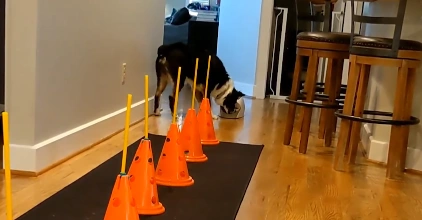
Most guides list commands alphabetically. This order builds on itself and prevents the most common problem behaviors: name recognition, a “yes” marker word, sit, leave it (prevents counter-surfing before it becomes a habit), come (the single most important safety command), down, stay, heel, and finally place/settle. Skipping straight to fun tricks before “leave it” and “come” is the most common mistake owners make with this breed. I see it constantly, and it’s such an easy one to avoid.
Managing the Herding Instinct
Herding behavior, circling, eye-stalking, nipping at heels, “gathering” running children, is genetic, not a training failure, and it cannot be eliminated, only redirected. The moment herding behavior starts, interrupt with a neutral sound, immediately cue an incompatible behavior like sit or come, and reward it generously. Just as important: give the dog a legitimate daily outlet, a flirt pole, herding balls, or fetch. A Mini Aussie with no outlet for herding drive will find one, usually your kids or your other pets. Punishment-based correction of herding nips tends to increase anxiety and escalate the behavior rather than stop it.

Crate and Potty Training
Crate training in the first two weeks is the single highest-leverage thing an owner can do. It solves potty training, prevents destructive chewing, and becomes the dog’s own choice of safe space when done right. Our potty training guide covers the exact routine that works fastest. Expect accidents to be normal at 8-12 weeks with trips outside every 45-60 minutes; bladder control improves through 3-4 months, and most Mini Aussies are reliable by 5-6 months, with full overnight reliability typically by 6 months. The most common crate-training mistake is using it as punishment, which destroys its value as a safe space.
Socialization: The Non-Negotiable Window
The critical socialization period runs roughly 3 to 14 weeks of age, much of it before vaccines are complete, so controlled exposure (carrying the puppy rather than letting them walk in unknown areas) matters. An undersocialized Mini Aussie tends toward fear-based reactivity later (our socialization guide covers this window in more depth), especially with strangers, given this breed’s naturally higher wariness of unfamiliar people. Before 14 weeks, aim for 20+ different people, 10+ novel environments, and controlled exposure to vaccinated, friendly dogs.
Professional Training: When and What Kind
Most Mini Aussies don’t strictly need a professional trainer, but a positive-reinforcement puppy class meaningfully speeds up socialization, especially for first-time herding-breed owners. For specific problem behaviors like herding nips or reactivity, a certified private trainer (look for CPDT-KA or IAABC credentials) is worth the cost. Board-and-train programs can work for owners short on time, but only at force-free facilities, and the owner still has to maintain the training at home afterward.
Common Training Mistakes With This Breed
The recurring pattern across problem Mini Aussies: under-stimulating a smart dog by drilling mastered commands, skipping impulse-control work in favor of fun tricks, using physical corrections that trigger anxiety in this sensitive breed, inconsistent household rules that a herding dog will test relentlessly, and assuming training “finishes”, when in fact adolescence (6-18 months) often brings real, developmentally normal regression that just needs renewed consistency rather than new teaching. See our adolescent phase guide if you’re in the middle of this stage right now.
Frequently Asked Questions
How long does it take to train a Mini Australian Shepherd?
Basic commands are typically solid within 4-8 weeks of consistent daily practice. Full reliability around real-world distractions usually takes 6-12 months, with adolescence often requiring renewed consistency rather than new teaching.
Can Mini Aussies be trained off-leash?
Yes, and many excel at it, but recall must be proofed extensively on a long line before any off-leash freedom in an unfenced area, given this breed’s prey drive and herding instinct.
Do Mini Aussies need a professional trainer?
Not strictly, but a positive-reinforcement puppy class in the first few months meaningfully improves socialization and often shortens the path to reliable manners.
Why does my Mini Aussie nip at heels?
This is herding instinct, not aggression, triggered by movement, running children, other pets, cyclists. It’s managed through redirection to an alternative behavior and a legitimate outlet for the herding drive, not through punishment.