
Why Is My Mini Aussie Afraid of Strangers? (And How to Help)
Short answer: Fear of strangers is common in mini aussies — the AKC breed standard itself describes them as reserved with strangers. It is usually a mix of genetics, missed early socialization, and accidentally reinforced fear. With patient desensitization and counter-conditioning, most fearful mini aussies improve significantly.
Why Mini Aussies Fear Strangers
Reserved-with-strangers is literally written into the breed standard. Miniature American Shepherds were developed as watchful farm dogs, and wariness of unfamiliar people is a feature, not a bug. That baseline caution becomes a real problem when it is amplified by genetics (nervous parents produce nervous puppies), a lack of positive exposure between 3 and 14 weeks of age, a frightening experience, or owners who comfort the fear in ways that accidentally reward it.
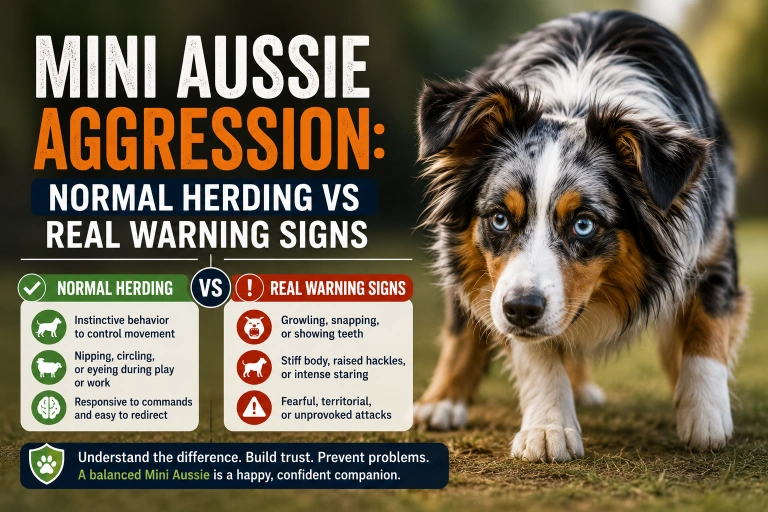
Fear often looks like aggression, which is why owners panic. A dog barking and lunging at a visitor is usually saying “stay away from me” — not “I want to attack.” True aggression is offensive and confident; fear-based reactivity is defensive and frantic. Knowing the difference changes the entire training plan.
Fear of Men Specifically
“My mini aussie is afraid of men” is one of the most repeated 2026 owner questions, with multiple fresh Q&As in August 2026 alone. Men tend to be taller, deeper-voiced, and more direct in their movements — all of which read as threatening to a cautious dog. Dogs that missed positive exposure to men during the socialization window often generalize: one scary man becomes all men, then all strangers.
The fix is the same desensitization process below, with men as the specific trigger. Ask male helpers to ignore the dog completely — no eye contact, no reaching, no looming. Toss treats away from the person so the dog learns good things happen near men without any social pressure.
Reactivity vs. Aggression: Telling Them Apart
Watch the body language. Fearful reactivity shows as barking with a tucked tail, cowering, retreating when given space, or snapping only when cornered. The dog wants distance. Genuine aggression shows as stiff forward posture, hard staring, and advancing toward the trigger. Most mini aussie “aggression” toward strangers is fear-based reactivity — the dog is trying to make the scary thing leave.
Either way, punishment makes it worse. Yelling at, leash-popping, or scolding a fearful dog confirms that strangers predict scary outcomes. If your dog has bitten or you cannot safely manage encounters, skip the DIY plan and hire a certified professional (look for IAABC or CCPDT credentials).
The 4-Step Desensitization Plan
Work below your dog’s reaction threshold — the distance where they notice the stranger but can still think and take treats. Progress is measured in weeks, not days.
- Manage the environment. Stop rehearsing the fear. Use distance, visual barriers, and quiet walking routes so your dog isn’t practicing panic daily. Every uncontrolled scary encounter sets training back.
- Pair strangers with good things. At a safe distance, the moment your dog notices a person, deliver high-value treats (chicken, cheese). Person appears → treats rain. Person leaves → treats stop. You’re rewiring the emotional response, not training obedience.
- Teach an incompatible behavior. Train a rock-solid “look at me” or hand-target at home first. On walks, cue it the moment a stranger appears at distance — a dog focusing on you cannot simultaneously fixate on the trigger.
- Raise criteria slowly. Decrease distance in tiny increments over sessions, and only when your dog is relaxed at the current distance. If barking returns, you’ve moved too fast — go back a step. Rushing is the number one reason desensitization fails.
Socialization: Prevention for Puppies
For puppies under 14 weeks, prevention beats cure. The AVSAB position statement is clear: puppies should meet many kinds of people — different ages, hats, uniforms, beards — in positive, treat-filled encounters during the socialization window. Puppy classes with a good trainer are worth their weight in gold. One rule: never force interaction. Let the puppy approach people on their own terms, and let people toss treats rather than reaching for the puppy.
When to Get Professional Help
Get a professional involved if your dog has bitten or snapped with contact, if fear is getting worse despite weeks of work, if the dog cannot eat treats around triggers (too stressed to learn), or if fear is paired with other issues like separation anxiety. A veterinary behaviorist can also assess whether short-term anti-anxiety medication would help training stick — for some dogs it is the difference between progress and stalemate.
Related Reading
- Mini Aussie Temperament Guide — the breed’s reserved nature and watchdog instincts
- How to Socialize a Mini Aussie Puppy — building confidence from the start
- Mini Aussie Training Guide — reward-based foundations for every behavior plan
Frequently Asked Questions
Why is my mini aussie suddenly afraid of men?
Sudden fear of men usually traces to missed socialization with men during puppyhood, a frightening encounter, or a fear period (puppies go through normal fear phases around 8–10 weeks and again at 6–14 months). Rule out pain or vision changes with a vet check first — a dog that suddenly fears handling may be hurting. Then work the desensitization plan with calm male helpers who ignore the dog and toss treats from a distance.
My mini aussie barks at the neighbor like he’s a threat. Is this aggression?
Almost certainly not — this is textbook territorial alert barking mixed with stranger wariness, and it matches many 2026 owner reports. Your dog is announcing an intruder near their territory, which is what the breed was developed to do. Manage it by blocking visual access (frosted window film works wonders), rewarding calm behavior when the neighbor appears, and never punishing the bark, which only adds stress to an already aroused dog.
Can you socialize an adult mini aussie that’s already fearful?
Yes, but the approach differs from puppy socialization. With adults you use desensitization and counter-conditioning — the gradual 4-step process above — rather than flooding them with new experiences. Adult dogs can absolutely learn new emotional responses; it just takes more repetitions and stricter management than with a puppy. Progress over 2–3 months of consistent work is the normal timeline.
Is fearfulness in mini aussies genetic?
Temperament has a strong genetic component, and puppies from nervous, undersocialized parents are more likely to be fearful — which is why MASCUSA and responsible breeders emphasize stable temperaments in breeding dogs. That said, genetics loads the dice; it doesn’t decide the outcome. Even a genetically cautious puppy raised with excellent early socialization usually grows into a functional, confident-enough adult.