
Mini Aussie vs Golden Retriever: Which Is Right for Your Family?
Short answer: Golden retrievers are the easier, more forgiving family dog; mini aussies are the smarter, sportier, higher-maintenance one. If you want a relaxed companion for kids and a busy household, pick the golden. If you want a sharp training partner and can give 1 to 2 hours of activity daily, the mini aussie will reward you like no other breed.
Side-by-Side Comparison
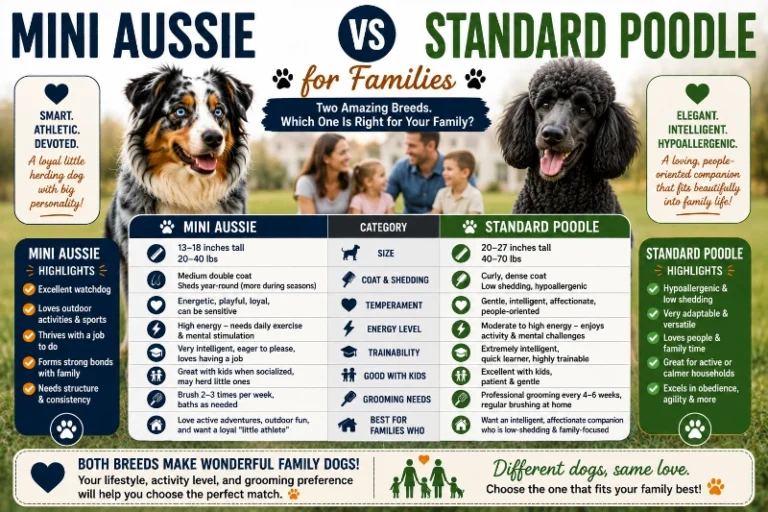
| Attribute | Mini Australian Shepherd | Golden Retriever |
|---|---|---|
| Size | 13–18 in, 20–40 lb | 21–24 in, 55–75 lb |
| Energy level | Very high — needs 1–2 hrs daily | High — needs 1+ hr daily |
| Temperament | Reserved with strangers, herding drive | Friendly with everyone, eager to please |
| Nipping / mouthiness | Common — herding instinct | Mouthy as puppies, outgrows it |
| Barking | Alert, frequent watchdog barking | Moderate — less territorial |
| Trainability | Extremely fast learner, needs a job | Eager, forgiving — great for beginners |
| Shedding | Year-round, heavy seasonal sheds | Heavy year-round shedder |
| Grooming | Weekly brushing | Weekly brushing, more coat to manage |
| Good with small kids | Yes, with supervision — may herd/nip | Excellent — famously patient |
| Apartment suitability | Possible with heavy exercise | Difficult — size plus energy |
| Lifespan | About 12–13 years | About 10–12 years |
| Puppy price (reputable breeder) | Roughly $800–$3,500 | Roughly $1,000–$3,500 |
Energy and Exercise Needs
Both breeds are sporting dogs that need real exercise, but the mini aussie takes it further. The AKC describes the Miniature American Shepherd as an agile, high-energy herder that needs at least an hour a day, ideally two, plus mental work. A golden is happy with a long walk, a swim, and a game of fetch. A mini aussie wants all of that plus a job — agility, herding games, trick training, or puzzle work. Without it, the mini aussie invents jobs you won’t like: herding your children, reorganizing your garden, or barking at the mail carrier with professional dedication.
Temperament: Herding Drive vs. “Cruise Control”
This is the real decision point. Golden retrievers were bred to work cooperatively with hunters all day — they are famously friendly, patient, and forgiving of beginner mistakes. Mini aussies were bred to control livestock independently — they are brilliant, intense, and reserved with strangers. That herding instinct shows up as circling, staring, and nipping at heels, including children’s heels. It is normal breed behavior, not aggression, but families with toddlers need to know it requires active training to manage.
In plain terms: a golden runs on cruise control, while a mini aussie is a sports car that needs an engaged driver. First-time owners succeed with goldens far more often; mini aussies reward experienced, consistent handlers.
Training Differences
Mini aussies learn faster — and misbehave more creatively. They pick up cues in a handful of repetitions, but they also learn your bad habits, loopholes, and inconsistencies just as fast. Goldens learn a bit slower but forgive sloppy timing and stay cheerful through the process. Both breeds respond best to reward-based training; aversive methods backfire on either, but a mini aussie will shut down or get reactive faster under harsh handling.
Size, Space, and Daily Life
The mini aussie’s 20-to-40-pound frame is the practical advantage: easier car travel, cheaper food and medication, and a realistic (if demanding) apartment dog. A 70-pound golden simply needs more of everything — space, food, and strength on the leash. On the other hand, goldens are sturdier with roughhousing kids, while a mini aussie can be overwhelmed by very young children and may try to herd them.
Grooming and Shedding
Call this one a draw — both shed. A lot. The mini aussie’s medium double coat needs weekly brushing (daily in spring and fall blowouts). The golden’s longer, denser coat needs the same, plus more attention to feathering and mats behind the ears and legs. Neither breed is hypoallergenic, and allergy sufferers should spend time with both before deciding.
Which Fits Your Household?
Choose the mini aussie if: you are an active person or family, you enjoy training as a hobby, you want a portable adventure partner, and you can commit to 1–2 hours of exercise plus mental work every day.
Choose the golden retriever if: you want a relaxed, famously kid-friendly companion, you are a first-time owner, or your household is busy enough that the dog needs to fit in rather than become a project.
Either way, buy from a breeder who health-tests: hips, eyes, and the breed-specific panels (for mini aussies that means PRA, MDR1, and cataract screening per MASCUSA guidance; for goldens, hips, elbows, heart, and eyes).
A Quick Note on Labradors
Families often compare all three. Labs sit between the two: friendlier and goofier than a mini aussie, a bit more boisterous than a golden, with similar exercise needs to a golden and a shorter, easier coat. If the mini aussie feels like too much dog but you want more spark than a golden, a well-bred Lab is worth a look.
Related Reading
- Mini Aussie Temperament Guide — the herding personality explained in depth
- Mini Aussie vs Border Collie — another high-energy comparison for active households
- Mini Aussie Exercise Guide — age-by-age activity needs before you commit
Frequently Asked Questions
Which is better for first-time dog owners, a mini aussie or a golden retriever?
The golden retriever, by a wide margin. Goldens forgive beginner mistakes, are less reactive, and don’t have herding instincts to manage. Mini aussies are wonderful dogs but they punish inconsistency — first-time owners often underestimate the training and exercise commitment and end up overwhelmed.
Are mini aussies good with kids compared to goldens?
Goldens are the gold standard for kid-friendly dogs: patient, sturdy, and tolerant. Mini aussies can be great with respectful older kids, but their herding instinct means nipping and circling young children, which requires supervision and training. With toddlers in the house, the golden is the safer pick.
Can a mini aussie live in an apartment where a golden couldn’t?
Size-wise, yes — a 30-pound mini aussie fits apartment life far more practically than a 70-pound golden. But the mini aussie still needs 1–2 hours of real exercise daily plus barking management, since alert barking causes neighbor complaints. An under-exercised mini aussie in an apartment is a recipe for noise complaints and chewed furniture.
Mini aussie vs Labrador — how do they compare?
Labs land between the two breeds: more easygoing and family-tolerant than a mini aussie, a little more exuberant than a golden, with a wash-and-go coat. Exercise needs are similar to a golden’s. If you like the idea of an active dog but the mini aussie’s intensity worries you, a Lab is the middle path.