How to Stop Your Mini Aussie Barking So Much
Short answer: Mini aussies bark because they were bred to be vocal watchdogs — alerting, herding, and boredom barking are all normal for the breed. You won’t train the bark out entirely, but you can cut it dramatically: meet the exercise need, manage triggers, and teach a “quiet” cue with rewards. Most owners see real improvement in 2 to 4 weeks.
Why Mini Aussies Bark So Much
Barking is a breed feature. The Miniature American Shepherd descends from working herders that used their voice to control livestock and alert owners — the AKC standard describes a watchful, alert dog. Modern mini aussies bark for four main reasons:
- Alert barking. The doorbell, a stranger at the window, a delivery truck — your dog is doing the job it was bred for. This is the most common type.
- Herding and excitement barking. Barking at running kids, bikes, other dogs, or the TV. Movement triggers the herding sequence, and barking is part of it.
- Boredom barking. A mini aussie getting less than an hour of real exercise will bark to make its own entertainment. This one is almost always an exercise problem wearing a barking costume.
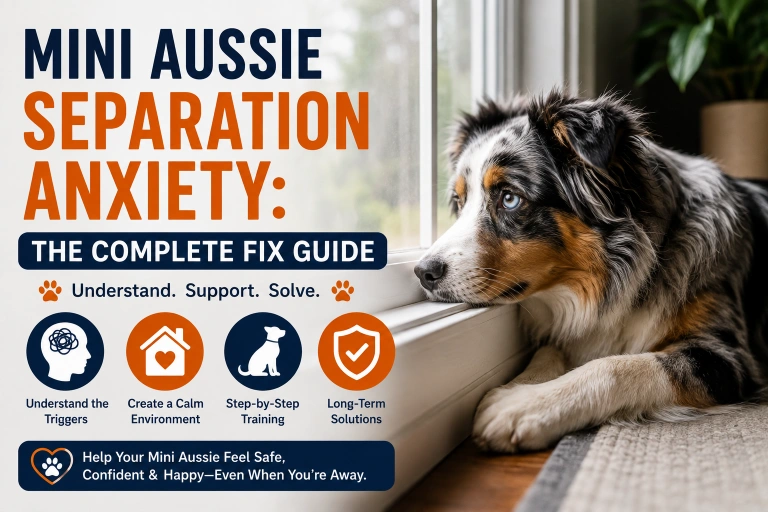
- Anxiety barking. Barking when left alone, often with pacing or destruction, points to separation anxiety rather than a training gap.
Identify which type you’re hearing before training. Recording a barking episode (or noting when it happens) tells you more than any generic advice can.
The 4-Step Quiet Training Plan
This works on alert and excitement barking — the two most common types. Train in short sessions when your dog is calm, not mid-barking-frenzy.
- Interrupt calmly. When barking starts, get your dog’s attention with a cheerful, upbeat interrupter — their name, a kissy sound, a hand clap — not shouting. Yelling sounds like you’re barking along, which is rewarding.
- Cue an incompatible behavior. Ask for something the dog can’t do while barking: “go to your mat,” “touch” (nose to your hand), or “find it” (toss a treat into the grass). Practice these cues at calm times first so they’re fluent under distraction.
- Reward the quiet. The instant your dog stops barking — even for two seconds — mark and treat. You’re building a reinforcement history for silence. Gradually stretch the quiet duration before treating: 2 seconds, then 5, then 10.
- Manage the triggers. Training halves the barking; management halves it again. Frosted window film for window-barkers, white noise for sound-reactive dogs, and a fenced yard instead of unsupervised front-yard access remove most rehearsal opportunities.
Apartment Living With a Barker
Apartment barking gets dogs evicted, so this deserves its own plan. The formula: exercise before quiet hours (a tired mini aussie is a quiet one), white noise or calming music to mask hallway sounds, window film so the dog can’t see every passerby, and a frozen Kong or long-lasting chew for the times you’re gone. Talk to your neighbors proactively — “we’re working on training” buys enormous goodwill. If your dog barks for more than a few minutes when alone, suspect separation anxiety and address that root cause rather than the barking alone.
Night Barking in Senior Dogs
A senior mini aussie that starts barking at night after years of quiet sleep needs a vet check, not a training plan. Night waking and vocalizing are classic signs of canine cognitive dysfunction, but pain, needing to urinate, and hearing or vision loss cause the same pattern. Rule out medical causes first. If it is cognitive decline, a strict daytime routine with good daylight exposure, evening mental enrichment, and keeping the sleeping area warm and familiar reduce night waking more than any training cue will.
What NOT to Do
- Don’t yell. Your dog hears a pack member joining the alarm. It escalates barking.
- Don’t use punishment collars as a first resort. Shock and citronella collars suppress barking through fear and pain, often creating anxiety or aggression without addressing the cause. They are banned or discouraged by every major humane training organization.
- Don’t accidentally reward it. Letting the dog out, giving attention, or tossing a treat to “shut them up” teaches that barking works. Reward quiet, not the off-switch.
- Don’t expect silence. A mini aussie that never barks is a mini aussie with a problem. The goal is a dog that alerts once and settles — not a mute one.
Related Reading
- Mini Aussie Temperament Guide — why the breed is wired to be vocal
- Why Won’t My Mini Aussie Calm Down? — settling an over-aroused dog
- Mini Aussie Exercise Guide — the activity needs behind most barking problems
Frequently Asked Questions
My mini aussie barks at the TV and the neighbors constantly. How do I stop it?
This is alert barking at perceived intruders — the breed’s watchdog job description. Start with management: frosted window film and keeping the dog away from the front windows during high-traffic times cuts most of it immediately. Then train the 4-step plan above, rewarding the moment your dog notices the trigger and stays quiet. “Barks at TV/neighbors” is one of the most repeated 2026 complaints, and management plus reward-based training resolves the majority of cases.
My neighbors complain about barking when I’m at work. What can I do?
First, find out what the barking sounds like — a pet camera tells you whether it’s alert barking at hallway noise (fixable with white noise and management) or distress barking with pacing (separation anxiety, which needs its own plan). Exercise hard before work, leave white noise on, and use food puzzles for the first hour alone. If barking continues for long stretches, talk to a certified trainer — and keep the neighbors in the loop, since knowing you’re actively training buys patience.
My 7-year-old mini aussie barks nonstop and nothing works. Is it too late?
It’s not too late — this exact scenario comes up regularly on dog forums, and older dogs learn new patterns fine. But a dog that has barked for years has a deeply rehearsed habit, so expect 4–8 weeks of consistent work rather than days. The usual missing piece in long-standing cases is management: owners train but never block the window, so the dog rehearses the old behavior 50 times a day between sessions. Fix the environment first, then train.
Do bark collars work on mini aussies?
They suppress barking the way a car alarm suppresses theft — through unpleasantness, not learning. In a sensitive, reactive breed like the mini aussie, punishment collars frequently increase anxiety and can redirect into fear-based aggression. Every major humane training body recommends against them as a first resort. Try the exercise-plus-management-plus-reward plan for a month first; it resolves most barking without fallout.